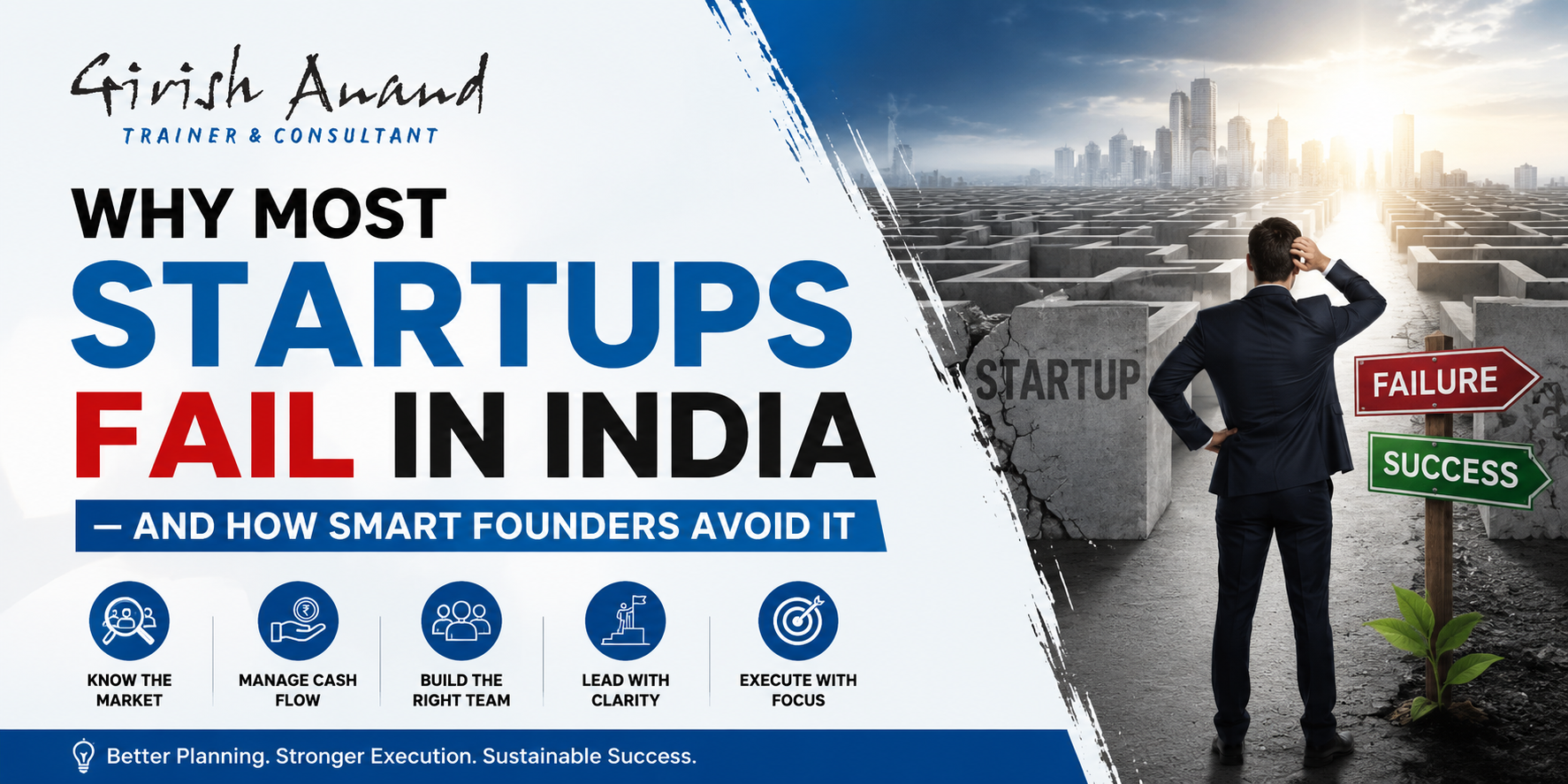
Starting a business is a dream for many people in India. Every year, thousands of startups are launched with exciting ideas, ambitious founders, and the hope of becoming the next big success story. However, the reality is harsh — a large number of startups shut down within the first few years.
The question is: Why do most startups fail in India?
The answer is not always lack of funding or competition. In many cases, startups fail because of poor planning, weak execution, leadership mistakes, hiring issues, and the inability to adapt to market demands.
Successful entrepreneurs understand that building a startup requires more than just a good idea. It requires strategy, discipline, smart decision-making, and consistent execution.
According to business mentor and leadership expert Girish Anand, many founders focus only on growth and ignore the foundation needed to sustain a business long term. Smart founders avoid these mistakes by preparing themselves before entering the market.
Lack of Proper Market Research
One of the biggest reasons startups fail is that founders build products without understanding the market.
Many entrepreneurs become emotionally attached to their idea and assume customers will automatically buy their product or service. But without proper research, even a great idea can fail.
Smart founders:
- Study customer behavior
- Analyze competitors
- Identify market gaps
- Validate demand before investing heavily
Understanding your audience helps in creating products that solve real problems instead of imaginary ones.
Poor Financial Planning and Cash Flow Problems
Cash flow is the backbone of every business. Many startups fail not because they are unprofitable, but because they run out of money.
Founders often spend aggressively on:
- Office spaces
- Marketing campaigns
- Large teams
- Unnecessary technology
Without financial discipline, expenses rise quickly while revenue takes time to grow.
Smart founders focus on:
- Budget control
- Sustainable growth
- Emergency reserves
- Tracking business expenses carefully
They understand the difference between “looking successful” and “building a sustainable business.”
Hiring the Wrong People
A startup’s success depends heavily on its team. Hiring people without evaluating skills, attitude, and cultural fit can create long-term problems.
Many startups make the mistake of:
- Hiring too fast
- Overhiring in early stages
- Ignoring employee mindset
- Avoiding accountability
This leads to poor productivity, toxic work culture, and internal conflicts.
Smart founders build smaller but stronger teams. They hire people who align with the company vision and are willing to grow with the business.
Weak Leadership and Decision-Making
Many startup founders are technically skilled but struggle with leadership.
A founder must inspire teams, handle pressure, solve conflicts, and make difficult decisions. Weak leadership creates confusion inside the organization and affects business growth.
Strong leaders:
- Communicate clearly
- Take responsibility
- Learn from failures
- Stay calm during challenges
- Build trust within teams
Leadership is not about control — it is about direction and execution.
Lack of Execution
Ideas alone do not build successful companies. Execution does.
Many startups spend too much time planning and discussing ideas without taking action. Others start quickly but fail to maintain consistency.
Smart founders focus on:
- Daily execution
- Measurable goals
- Process improvement
- Customer feedback
- Continuous learning
The ability to execute consistently often matters more than having a revolutionary idea.
Ignoring SWOT Analysis
A SWOT Analysis helps businesses identify:
- Strengths
- Weaknesses
- Opportunities
- Threats
Many startups ignore this important business strategy tool and enter markets blindly.
Smart entrepreneurs regularly analyze:
- Their competitive advantages
- Market risks
- Business weaknesses
- Future opportunities
This helps them make better decisions and prepare for challenges before problems arise.
Scaling Too Fast
Rapid expansion may look exciting, but scaling without preparation is dangerous.
Many startups fail because they:
- Expand to multiple cities too early
- Spend heavily on branding
- Increase operations without systems
- Ignore customer experience
Growth without structure creates operational chaos.
Smart founders focus on building strong systems before scaling. They grow steadily rather than chasing short-term hype.
Not Adapting to Change
The business world changes rapidly. Customer behavior, technology, and market trends evolve continuously.
Startups that refuse to adapt eventually struggle to survive.
Successful founders:
- Listen to feedback
- Observe market trends
- Upgrade skills
- Improve products regularly
Adaptability is one of the most important qualities of modern entrepreneurs.
Building a Startup Requires Mindset and Discipline
Startup success is not only about funding or innovation. It is also about mindset, patience, leadership, and discipline.
Every entrepreneur faces failures, setbacks, and uncertainty. What separates successful founders from failed ones is their ability to learn, adapt, and continue moving forward.
Business growth takes time, consistency, and strategic thinking.
Final Thoughts
India has incredible startup potential, but success requires more than passion alone. Founders who avoid common mistakes, focus on execution, build strong leadership skills, and understand the market are far more likely to succeed.
Smart entrepreneurs know that sustainable businesses are built through preparation, discipline, and continuous improvement.
As highlighted by leadership expert Girish Anand, startups succeed when founders combine vision with practical execution and strong decision-making.